

History of CEBE at the University of Rwanda
From its founding through African Development Bank support to becoming a world-class seven-storey hub of innovation at Kigali Innovation City — the full story of the Centre of Excellence in Biomedical Engineering and eHealth.
Background
The Centre of Excellence in Biomedical Engineering and eHealth (CEBE) was established at the University of Rwanda (UR) and located in the Kigali Innovation City (KIC) through funding from the African Development Bank (AfDB). Its founding aim was to develop human capital for inclusive growth in Biomedical Engineering, eHealth and Rehabilitation Sciences — addressing a critical skills gap across the East African Community (EAC) and Africa in general.
CEBE's strategy is to enhance regional capacity through engaging regional scholars and strengthening partnerships between academia, government, and the private sector. Its strategic placement within the Kigali Innovation City enables close collaboration with technology, research, and innovation partners established in KIC.
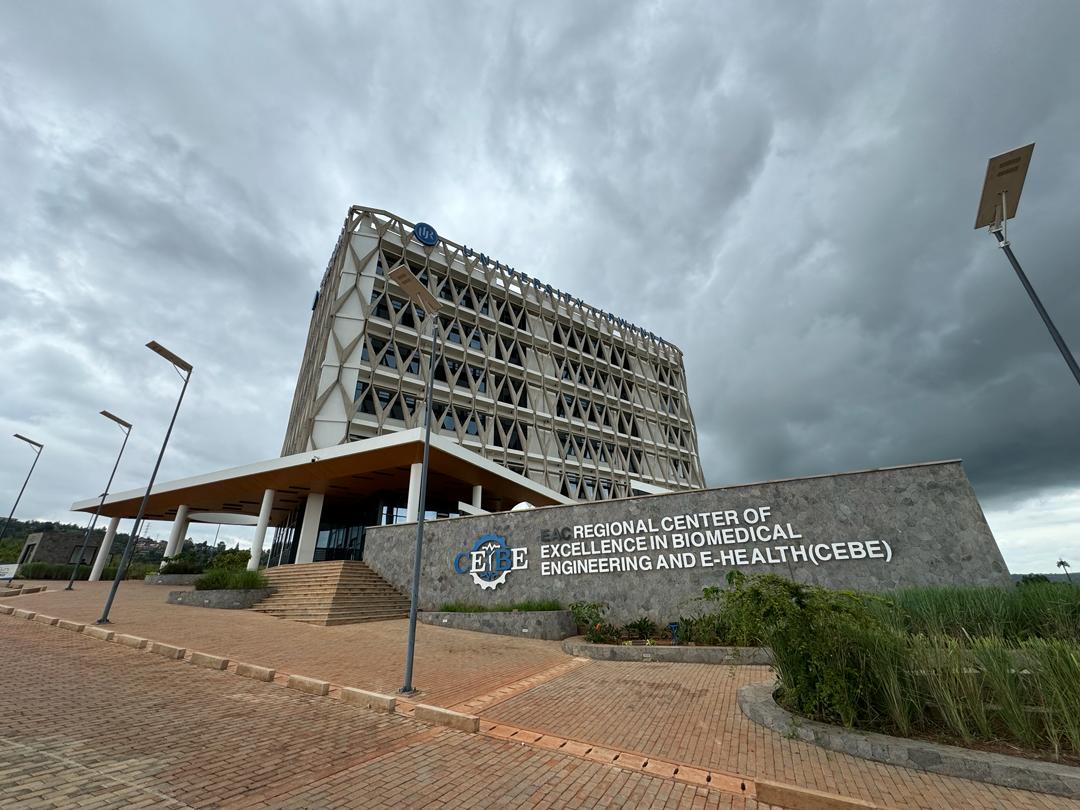
CEBE building established at Kigali Innovation City
Human Capital Development
Building a skilled workforce through academic programmes and professional courses in biomedical engineering and eHealth.
Regional Partnership
Engaging scholars and institutions across East Africa to foster collaborative research and shared knowledge.
AfDB Funding
Established through the African Development Bank, providing the financial backbone for infrastructure and programmes.
Innovation Ecosystem
Strategically embedded in Kigali Innovation City alongside leading technology and research partners.
Key Achievements — Phase I (2016–2023)
CEBE has contributed significantly to skills development in Biomedical Engineering, eHealth, Rehabilitation and Mobility Sciences. Capacity development spanned short-term Advanced Professional Courses (APCs) for in-service professionals, as well as Masters, PhD and postdoctoral programmes.
In total, 620 people were trained under CEBE. All PhD and postdoctoral graduates are now serving at the University of Rwanda for teaching and R&D, while more than 80% of MSc graduates are serving in healthcare facilities across Rwanda. Training was conducted under the three CEBE thematic areas both in Rwanda and across partner countries in the region.
Degree Programmes
- PhD graduates — serving at UR for R&D and teaching
- Postdoctoral researchers — advancing cutting-edge research
- MSc graduates — 80%+ placed in Rwanda's healthcare system
Professional Development
- Advanced Professional Courses (APCs) for in-service professionals
- Training in Biomedical Engineering, eHealth & Rehabilitation
- Programmes delivered in Rwanda and across the EAC region
A seven-storey building was constructed within the Kigali Innovation City (KIC) to anchor CEBE's contribution to Rwanda's technology and innovation ecosystem. The building complex boasts state-of-the-art facilities, including first-class laboratories dedicated to Biomedical Engineering, Prosthetics and Orthotics, and eHealth, alongside office space and communal facilities.
The CEBE building at Kigali Innovation City has a total capacity of 824 people, providing a world-class environment for research, teaching, and health-technology innovation.
Delegates visiting the CEBE biomedical and rehabilitation labs
CEBE researchers have made significant contributions to digital healthcare platforms, assistive technologies, and health solutions tailored to the needs of the East African population. Notable outputs and innovations from Phase I include:
45 publications in refereed and indexed international journals and conference proceedings, evidencing CEBE's contribution to global scientific knowledge.
Diversified grant funding mobilised from SIDA, the NIH, and additional external sources, complementing the core AfDB investment.
International academic partnerships established with Stanford University, Purdue University, Colorado State University, UGHE, and other leading global institutions.
EAC Digital Rehabilitation Hub established in Rwanda in partnership with JAMK University of Applied Sciences (Finland) and six East African universities — Jomo Kenyatta University of Agriculture & Technology, MOI University, State University of Zanzibar, Kilimanjaro Christian Medical College, UGHE, and UR.
Data Science for Health scholarships — 16 MSc graduates, 4 PhDs, 2 postdoctoral researchers, and 2 junior faculty trained through complementary funding.
Smartphone-based diabetes self-management — pilot study on the use of a mobile application for self-management of type 2 diabetes in Rwanda, a first of its kind in the country.